

Golden Falcon Quality Register System Dubai

termites


 Termites Treatment – 7 Signs 

Drywood Termites. They can hide in your home’s foundations, windows, and door frames for ages without being visible.They feed on any piece of wood you find around your home, from furniture to skirting boards

You need to look for signs of termites in your home.If you know dry wood termites are in the neighborhood, it is a good idea to make regular checks around your house or apartment to catch them as early as possible and prevent termite damage to your home.

Here are seven signs of termites that you might have these unwanted guests living in your home.

One sign of termites is quiet clicking sounds, that come from the walls.Soldier termites bang their heads against the wood or shake their bodies when the colony disturbs to signal danger to the other termites.

The worker termite loves eating, your woodwork.If you put your ear close to any wood infested by termites, you can hear them munching away.This noisy eating habit was even mentioned by the Roman writer Pliny the Elder 2,000 years ago!

A little known fact

 Termite is that termite love rock music, A recent study regarding the eating habits of termite found that these wood-addicted insects work faster when they hear rock music.When researchers subjected selections of termite to a rock track, they ate wood two times faster!

Termites are sensitive little creatures.They detect vibrations and noises using several organs found at the base of their antennae and on the tibia (one of the segments of the leg).

Usually the first sign of a termite infestation is the presence of flying termite — called warmers or alates.The flying termite are males and females that leave the nest to find a mate and then establish a new colony — which could be near or in your home.Read more about these winged termites in our previous blog Why Flying Termites Mean Serious Trouble.

Some species swarm at night and are attracted to light sources.Other species swarm in daylight, but all drywood termites tend to swarm after rain at particular times of the year.

Another common sign of termites is the discarded wings.Flying termites lose their wings shortly after finding a mate.Male and female drywood termite pair up and then crawl to a suitable nesting site where they seal themselves in to mate and start the new colony.The king and queen start off by caring for their young until enough workers take over.The king continues to tend for the queen, and the pair can live together in the growing colony for over ten years.

Did you know that in some termite species, the males die shortly after mating!

A common mistake people make is confusing termite with white ants.This misconception is easy to make as ants and termite are very similar in both shape, size, and in some cases behavior.

Differences between Ants and Termites?

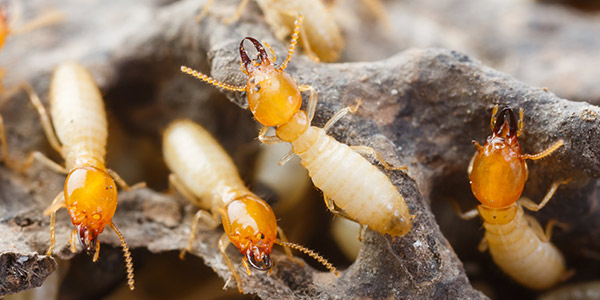
Termites are light in color.They usually appear white or creamy and can sometimes look quite translucent.

Compared to ants, termites’ antennae are completely straight rather than bent.

The waist section of a termite is a lot thicker than that of an ant.The section where the thorax meets the abdomen is very narrow on an ant, whereas on a termite this section is quite large.

Both flying ants and termite have two sets of wings.However, a termite’s wings are both the same size compared to an ant, which has one set larger than the other.

The important thing to note is that there is no such thing as a white ant.If you think you have spotted an insect that looks like a white ant in and around your house, then you might have a termite problem on your hands.

Drywood termite Behaviour 

Drywood termite usually consume wood from the inside out, leaving a thin veneer of timber or just the paint.When you knock or tap on an area that has termite damage, it sounds hollow or papery.This is because part or all of the timber inside has been eaten away and is another one of the signs of termite.

Often related to signs of damp and hot weather, stiff windows and warped doors can also indicate termite!The moisture they produce when eating and tunneling through door and window frames causes the wood to warp, making it tough to open doors and windows.

Various types of technology have proposed detecting tunnels and the activity of termite

This indicator of an infestation is something. Unlike subterranean termite, drywood termite don’t use their feces to build their tunnels. Instead, they push it out of small holes near the entrances to their nests. This results in small black marks and a dark powdery substance around the area they are infesting.

We are best Pest Control Companies across UAE.We use the best Municipality approved medicine. Contact us for more information About termite treatment.

Tags:

Anti Termites
Termite Control
Termite Pest Control
White Ants


termites

termites

 Termites Treatment – 7 Signs 

Drywood Termites. They can hide in your home’s foundations, windows, and door frames for ages without being visible.They feed on any piece of wood you find around your home, from furniture to skirting boards

You need to look for signs of termites in your home.If you know dry wood termites are in the neighborhood, it is a good idea to make regular checks around your house or apartment to catch them as early as possible and prevent termite damage to your home.

Here are seven signs of termites that you might have these unwanted guests living in your home.

One sign of termites is quiet clicking sounds, that come from the walls.Soldier termites bang their heads against the wood or shake their bodies when the colony disturbs to signal danger to the other termites.

The worker termite loves eating, your woodwork.If you put your ear close to any wood infested by termites, you can hear them munching away.This noisy eating habit was even mentioned by the Roman writer Pliny the Elder 2,000 years ago!

A little known fact

 Termite is that termite love rock music, A recent study regarding the eating habits of termite found that these wood-addicted insects work faster when they hear rock music.When researchers subjected selections of termite to a rock track, they ate wood two times faster!

Termites are sensitive little creatures.They detect vibrations and noises using several organs found at the base of their antennae and on the tibia (one of the segments of the leg).

Usually the first sign of a termite infestation is the presence of flying termite — called warmers or alates.The flying termite are males and females that leave the nest to find a mate and then establish a new colony — which could be near or in your home.Read more about these winged termites in our previous blog Why Flying Termites Mean Serious Trouble.

Some species swarm at night and are attracted to light sources.Other species swarm in daylight, but all drywood termites tend to swarm after rain at particular times of the year.

Another common sign of termites is the discarded wings.Flying termites lose their wings shortly after finding a mate.Male and female drywood termite pair up and then crawl to a suitable nesting site where they seal themselves in to mate and start the new colony.The king and queen start off by caring for their young until enough workers take over.The king continues to tend for the queen, and the pair can live together in the growing colony for over ten years.

Did you know that in some termite species, the males die shortly after mating!

A common mistake people make is confusing termite with white ants.This misconception is easy to make as ants and termite are very similar in both shape, size, and in some cases behavior.

Differences between Ants and Termites?

Termites are light in color.They usually appear white or creamy and can sometimes look quite translucent.

Compared to ants, termites’ antennae are completely straight rather than bent.

The waist section of a termite is a lot thicker than that of an ant.The section where the thorax meets the abdomen is very narrow on an ant, whereas on a termite this section is quite large.

Both flying ants and termite have two sets of wings.However, a termite’s wings are both the same size compared to an ant, which has one set larger than the other.

The important thing to note is that there is no such thing as a white ant.If you think you have spotted an insect that looks like a white ant in and around your house, then you might have a termite problem on your hands.

Drywood termite Behaviour 

Drywood termite usually consume wood from the inside out, leaving a thin veneer of timber or just the paint.When you knock or tap on an area that has termite damage, it sounds hollow or papery.This is because part or all of the timber inside has been eaten away and is another one of the signs of termite.

Often related to signs of damp and hot weather, stiff windows and warped doors can also indicate termite!The moisture they produce when eating and tunneling through door and window frames causes the wood to warp, making it tough to open doors and windows.

Various types of technology have proposed detecting tunnels and the activity of termite

This indicator of an infestation is something. Unlike subterranean termite, drywood termite don’t use their feces to build their tunnels. Instead, they push it out of small holes near the entrances to their nests. This results in small black marks and a dark powdery substance around the area they are infesting.

We are best Pest Control Companies across UAE.We use the best Municipality approved medicine. Contact us for more information About termite treatment.

Index